Table of Contents
How AI Will Change SEO in 2026: Trends Every Marketer Must Know
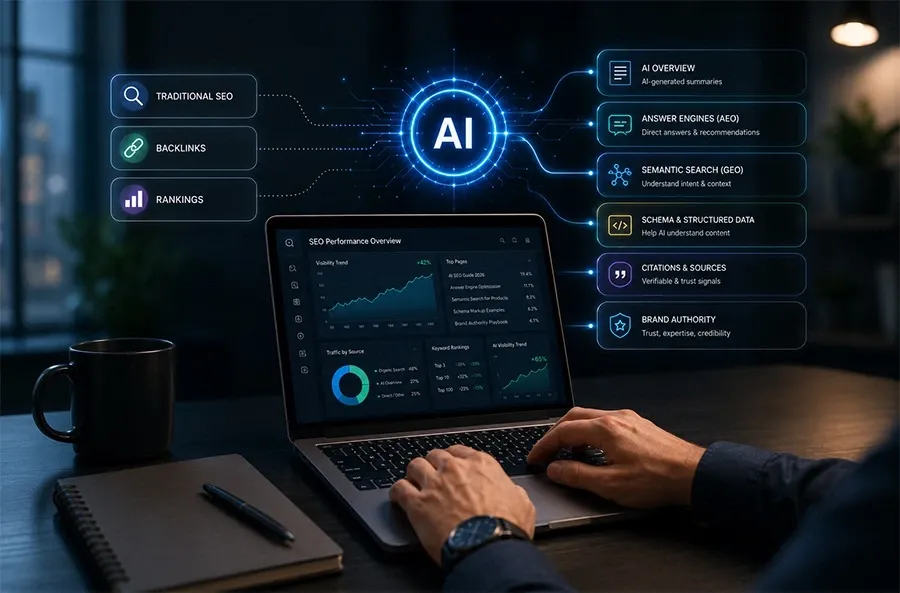
If you are still counting on keywords, backlinks, and page one rankings – then you are already behind the times. And this perfectly illustrates the impact of AI on SEO in 2026.
But these elements do not cease to be important; it is just that the competition will grow to an unprecedented level.
SEO is no longer just about ranking on Google’s first page. In 2026, brands need to create authoritative, trustworthy content that AI platforms can understand, cite, and recommend directly to users.
The answers generated by Google AI Overview, ChatGPT search, Bing Copilot, and Perplexity reach hundreds of thousands of internet users without them ever having seen a single blue link from the list. If you are not among the sources used for these answers, your brand simply ceases to exist for some parts of your target audience.
This isn’t something that will happen in the future; this is happening right now.
This is exactly what you must know about AI SEO 2026 and how you should respond to it.
No Ranking Equals No Visits
Be honest, being #1 on Google does not necessarily mean getting traffic anymore.
AI-generated Overviews, created by Google’s AI algorithms and presented to the user instead of organic results, continue gaining more and more popularity in 2026. They give the user a quick overview and summary of what they have asked for – providing an instant answer and removing the need to click through anything else.
As shown by the latest statistics, these Overviews lower the click-through rate on the top-ranking website by 34.5%, on average.
It is a hard truth about zero-click search that cannot be ignored anymore.
The bottom line?
Being ranked no longer matters as much as before. What really counts is whether your site was referenced in an AI Overview or not.
There Are Two Completely Different SEO Positions Today
This is the single-most important strategic shift that occurred in 2026, and yet most marketers still consider there to be only one position called SEO.
There isn’t one. There are two:
Optimizing content for human readers who are comparing, reading, clicking, and buying. Your ranking, click-through rate, and experience on your website. Important stuff, but just one side of the equation.
Delivering valuable content to machines that will then analyze and utilize the data in ways that have nothing at all to do with users clicking on your content.
The term for this may differ – Generative Engine Optimization (GEO), Answer Engine Optimization (AEO), AI Overview Optimization, etc. But it all means the same thing.
New Standards for Content Quality Have Emerged
For ages, the phrase “quality content” could be loosely interpreted to mean whatever content one pleased.
However, AI algorithms analyze content in much the same way an editor would, scrutinizing the structure and verifiability of the content. Low-quality filler content is being filtered out by AI on a large scale, making it abundantly clear – how AI has transformed SEO in 2026.
The qualities shared by content cited by AI algorithms in 2026 include:
- Answering the posed question in the beginning rather than in the middle of the text, after 400 words
- Including new insights or data that do not appear in other sources
- Using proper formatting with clear H2s, bullet answers, TL;DR sections, and FAQ blocks
- Having reliable information with sources cited, names of the studies mentioned, and actual figures used
Generic blogs have become a dime a dozen. Content created by experts and formatted accordingly is what AI algorithms use.
AI Transforms Keyword Research
Traditional keyword research involved search volume and competitiveness. You would find out your keyword, create content around it, and attain your desired ranking.
The notion of “keyword research” has been radically transformed by artificial intelligence. It further proves that AI technology has revolutionized SEO for 2026.
With the help of AI technologies, you are not limited to finding out what keywords people are searching for – you know why they are looking for those keywords, what they need, and how it all links to a complex network of other groups.
It is referred to as semantic optimization, which includes:
- A piece of content can rank on multiple keyword searches if created within a topic cluster, not just for one particular keyword.
- Long-tailed keyword searches are more important than ever before – because people now speak to AI chatbots.
- Matching intents is much better than keyword stuffing in any update.
Stop creating content targeting one keyword; rather, create content answering one topic and allow AI to determine the whole cluster for you.
Technical SEO Complexity Is Here to Stay
The following may come across as strange, but here is a paradox: as the implementation of AI technology becomes easier in relation to on-page SEO, it makes technical SEO even harder.
Three technical SEO elements – will be critical in 2026:
Structured Data (Schema Markup)
Bot Management
LLMs.txt
Brand Authority Will Be An SEO Factor In 2026
Google has always favored authorities. However, in 2026, AI systems will verify your brand authority throughout the Internet, rather than just on your website. That is the essence of the impact AI will have on SEO in 2026.
This implies that your SEO package will be influenced by:
- Your mention rate on Reddit, LinkedIn, forums, and industry magazines
- The degree of consistency of your messaging on your site, social media pages, Google My Business, and external reviews
- If your business has any unique, proprietary content, research, case studies, or data
Weak off-site brand authority is hurting businesses more than ever before through Google’s updates. Brand authority is not a PR function anymore; it’s an SEO function.
The Age of Agentic Web Is Approaching – And It Will Change Everything Once Again
As the capabilities of AI progress from answering to actions, yet another revolution is underway in SEO in 2026.
AI is progressing from being an answer engine to an action engine.
When using agentic AI, not only are the right running shoes selected for the user, but the system also finds out their correct size, applies a discount coupon, and completes the purchase. Without human intervention.
This implies a whole additional layer of optimization for search engines – the compatibility of your site content with machines.
If an AI agent fails to read the prices, inventories, or descriptions of the products you sell, you do not exist on this level of transactions.
It’s all early stage, yet those who start getting ready today will have a substantial advantage tomorrow.
Hyperlocal SEO Becomes The Latest SEO Trend Because of Personalization
Searches have become increasingly personalized thanks to AI-based technology. This is yet another example of how AI is transforming SEO in 2026. When two individuals enter the same term in their searches, one from Delhi and another from Mumbai – they will see completely different results.
For small-scale businesses and startup companies – this can be seen as a golden chance rather than a hindrance.
This is because personalization due to AI favors specificity. A business operating locally and knowing about its consumers, using regional languages, addressing regional problems, and having a good Google Business Profile will outperform a national brand in personalized local searches.
Local SEO in 2026 transcends mere “near me” searches.
Actions You Should Start Right Away
Taking into account all of what was said above, consider this helpful list of actionable recommendations:
Make sure your content is Q&A optimized
Does your content answer questions in a proper way somewhere near the beginning of your website’s pages? Otherwise, restructure it. It should include such elements as TL;DR, FAQ, and a structure with headers H2.Apply the missing schemas
The least that should be done by now is using Article, FAQ, HowTo, and LocalBusiness schema. You may also refer to the Google Rich Results test.Prepare a semantic map of keywords rather than a simple keyword list
Group your topics and make a few pillar articles based on each group, rather than writing one separate article per keyword.Start monitoring AI citations rather than rankings
BrightEdge, SE Ranking, and Semrush begin creating an AI Overview track. Begin by checking whether you appear in any AI-driven responses, rather than just ranking positions.Improve off-page brand signals
Ensure that your company is mentioned in all relevant forums and media publications. Obtain reviews on Google, Yelp, and other platforms.Optimize your Google Business Profile
This is crucial for businesses and agencies looking to perform SEO for 2026.Create for people first, optimize for machines secondly
AI is smart enough to recognize when something has been written in an attempt to trick the algorithm. The best performing pieces in 2026 will be helpful, high-quality content that is easily cited by machines.
Conclusion
AI has not killed SEO; it has raised the bar to the point where only high-quality, well-structured, and credible content will succeed.
The brands that see it as a challenge will keep chasing irrelevance. The brands that embrace it will create a long-term brand identity, develop authority through their content, and generate AI traction that accumulates over time.
The search box in 2026 does not give links anymore; it gives answers. It analyzes credibility and influences decisions.
It’s not about AI’s impact on SEO. It’s about which brand becomes the answer.
Frequently Asked Questions
Is SEO still relevant in 2026?
Yes, but only when paired with AI Search Optimization (AEO/GEO). Although rankings are essential for traffic, it’s important to have citations to gain credibility and zero-click searches.
What is Generative Engine Optimization (GEO)?
GEO is the process through which your content is structured in a way that allows the AI-based search engine, like Google AI Overviews, ChatGPT Search, and Perplexity, to accurately understand and cite your content in their responses.
How do I find out whether AI Overviews cite my content?
Utilize services like BrightEdge and SE Ranking, or try manually checking your target keywords on Google without being logged into your account and note any changes made to your AI results.
Will AI-generated content harm SEO in 2026?
Human-assisted AI-generated content is fine; however AI-generated content with minimal input from humans will not do. Google has become very smart in distinguishing fluff. They will reward you for insights, facts, and expertise.
How important is the schema markup in AI SEO?
Very important. The schema markup is probably the only way that AI can understand what your content entails and if it is credible enough to be cited.